
The Daily Micro-Practices That Build Trust
By Ilhiana Rojas Saldana • February 15, 2026

In today’s leadership environment, trust is not optional. It is foundational.
No matter how much we value transparency, culture, or engagement, trust is built — and sometimes quietly fractured — through habits we don’t always realize we’re practicing. It lives in the micro-moments of daily leadership: the tone we use, the pace we set, the way we respond when someone challenges an idea, and how we show up when no one is paying close attention.
Although these moments may feel small, their impact is not. They accumulate. And over time, they shape whether people feel confident and secure with us — or cautious around us.
Most of the time, this is not deliberate. We are not intending to erode trust. We are simply operating from what feels natural to us. We communicate in the way we prefer to receive communication. We move at the speed that feels responsible to us. We make decisions using the logic that feels sound to us. We give feedback the way we believe it should be delivered.
In other words, we treat others the way we believe is fair, respectful, and effective.
That approach reflects integrity. But it overlooks something critical: not everyone experiences trust the same way.
For some, trust grows when direction is clear and decisions are decisive. For others, trust grows when there is space to process and contribute. Some people feel safe in structure and predictability; others feel safe in flexibility and autonomy.
When these differences go unrecognized, friction emerges — not because trust is lacking, but because it is being experienced differently.
I often see this in many teams. The goals are aligned. The talent is strong. The commitment is real. Yet under sustained pressure, small behavioral patterns begin to intensify — and what once felt energizing or stabilizing starts to feel strained. The erosion is rarely dramatic. It is incremental.
We Build Trust From Our Own Lens
This is where behavioral awareness becomes a powerful leadership lens.
Tools like D.i.S.C.* help illuminate the patterns that shape how we naturally communicate, make decisions, respond to pressure, and prioritize relationships versus results. These patterns influence not only how we attempt to build trust, but how we interpret it in others.
For example:
- A results-driven leader may convey trust by moving quickly, making firm decisions, and demonstrating confidence in the path forward.
- A relationship-centered leader may covey trust by inviting discussion, encouraging participation, and ensuring every voice feels acknowledged.
- A consistency-focused leader may convey trust by creating predictability, maintaining routines, and minimizing unnecessary disruption.
- A detail-oriented leader may convey trust by analyzing thoroughly, asking clarifying questions, and reducing risk before moving forward.
Each reflects a different leadership strength.
The tension begins when we assume our expression of trust is universal.
Consider a common scenario: A leader ends a meeting by quickly assigning action steps and moving on. To them, this demonstrates clarity and momentum. To someone who prefers discussion, it may feel as though their input was not fully considered. Or imagine a team member who asks multiple follow-up questions before committing to a decision. To them, this demonstrates responsibility. To someone else, it may feel like resistance.
Under pressure, these patterns intensify. We lean further into what feels natural — pushing harder, slowing down, asking more questions, or seeking more dialogue. And in that space between intention and interpretation, trust is tested.
Trust, therefore, is shaped not only by what we intend, but by how our patterns are experienced by others.
The Micro-Practices That Shape Trust
The encouraging truth is that building trust does not require changing who you are. It requires becoming more intentional in how you respond — especially in moments that test you.
Small, disciplined adjustments can significantly strengthen trust over time
1. Regulation Before Reacting
Trust is shaped most visibly in moments of tension — when someone disagrees with you, when a mistake is made, or when results fall short.
Different leaders default differently in these moments. Some increase intensity. Some become directive. Some withdraw. Some begin analyzing every detail. These reactions are not flaws; they are patterns. But when those patterns operate unconsciously, they can create unintended distance.
Micro-practices:
- Pause before responding when something triggers you.
- Ask yourself, “What outcome do I want from this conversation?”
- Slow your pace intentionally.
- Replace immediate judgment with curiosity
- Say, “Help me understand your thinking.”
Trust strengthens when people experience you as grounded, curious, and open rather than reactive.
2. Clarity Over Assumption
Trust strengthens when expectations are spoken, not implied.
Leaders who naturally move quickly may assume alignment without checking for understanding. Leaders who value collaboration may assume that discussion equals agreement. Leaders who value precision may assume that detailed explanation ensures clarity.
Yet clarity is not about how much you say — it is about whether others leave with shared understanding.
Micro-practices:
- Ask, “What are your next steps?”
- Ask yourself, “Have I defined what success looks like?”
- Clarify ownership and timelines explicitly.
- Distinguish gently between exploration and decision: “We’re gathering input,” or “The recommendation is to move forward with this direction.”
Trust deepens when ambiguity decreases.
3. Follow-Through on Small Commitments
Trust is built more often in small follow-through than in large promises.
Reliability signals accountability. When leaders consistently close loops and honor commitments — especially the small ones — people feel respected and secure investing effort and energy.
Micro-practices:
- Confirm what you committed to before the conversation ends.
- Send the recap you promised — even if it feels minor.
- If priorities shift, communicate early rather than silently.
- Ask, “Is there anything I may be missing before we move on?”
Trust grows when reliability becomes predictable.
4. Addressing Tension Early
Unaddressed tension rarely disappears. It compounds.
Some leaders instinctively confront issues immediately. Others delay to preserve harmony. Both instincts are understandable. However, when tension is left unattended, assumptions take root.
Micro-practices:
- Say, “I sense something may be off — can we talk about it?”
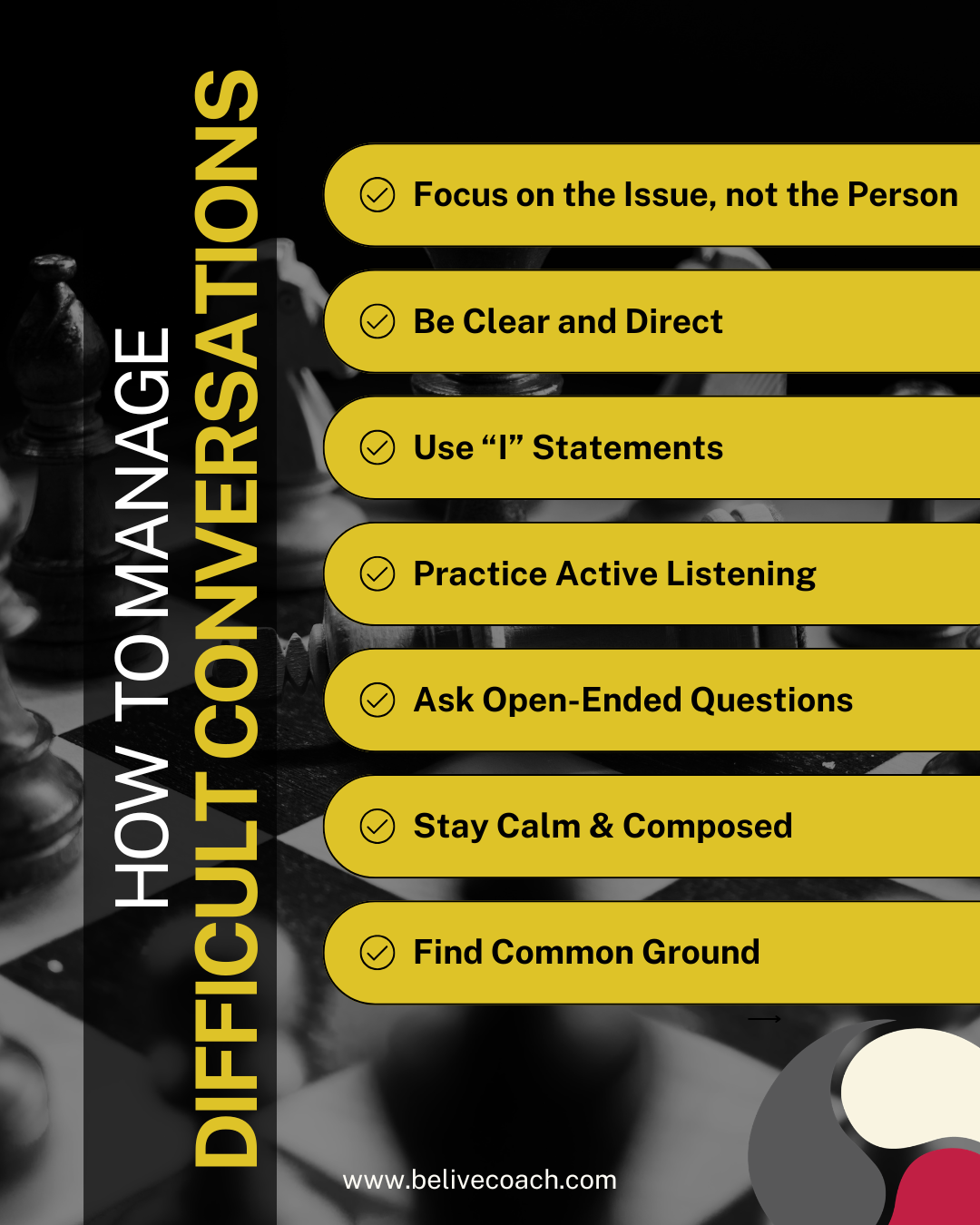
- Describe the behavior or action without labeling or judging the person. "I noticed this happened" vs. "You did this"
- Ask yourself, “What perspective might I be missing?”
- Address misalignment within 24–48 hours rather than weeks later.
Trust deepens when difficult moments are navigated with respect and timeliness.
5. Recalibrating Promptly
Trust is not built on perfection. It is built on accountability and recalibration.
When something does not land as intended — a rushed response, an unintended tone, a missed perspective — the most powerful move is not defensiveness. It is recalibration.
Micro-practices:
- Say, “Let me clarify what I meant.”
- Say, “I may have moved too quickly there.”
- Say, “I can see how that could be interpreted differently.”
- Ask, “How can we realign moving forward?”
Trust strengthens when leaders prioritize alignment over being right.
When Awareness Becomes Intention
Research on psychological safety reinforces that people are more likely to contribute, innovate, and perform at higher levels when they feel respected in how they engage. Trust is not about unanimous agreement; it is about responsiveness. It reflects a leader’s willingness to adjust based on how their behavior is experienced.
When leaders become conscious of their daily micro-practices — especially those that intensify under stress — trust shifts from accidental to intentional.
As you reflect on your own leadership, consider:
- When deadlines tighten or stakes rise, what becomes more pronounced in your behavior?
- Where are you predictable, and where might you be inconsistent?
- Who on your team might need a slightly different approach in order to feel secure and respected?
- What small daily adjustment would meaningfully increase trust on your team?
Trust is not built in extraordinary moments alone. It is built in the disciplined repetition of everyday behaviors.
What you practice consistently becomes the environment others experience. And once you begin noticing those patterns, you gain the ability to shape them with intention.
That is where real leadership begins.
If your team is navigating trust challenges or if you want to strengthen trust across your organization — I’d be honored to support you.
Let’s explore how we can build a culture of trust, connection, and performance together.
Topics: D.i.S.C., Trust, Communication, Presence, Teams
* About D.i.S.C.
The D.i.S.C. model is a research-based behavioral framework that helps individuals understand how they naturally communicate, make decisions, and respond to their environment. It highlights four broad tendencies—Dominance, Influence, Steadiness, and Conscientiousness—which reflect different communication needs, pacing, priorities, and ways of processing information. Rather than labeling or categorizing people, D.i.S.C. serves as an awareness tool that supports leaders in recognizing their own patterns, understanding the diverse ways others communicate, and reducing misinterpretation or tension in everyday interactions. By using DISC to appreciate these differences, leaders can create more meaningful conversations, improve collaboration, and ensure their message is received with clarity, trust, and psychological safety. Learn more about D.i.S.C. here.

Ilhiana Rojas is a Human Potential Expert, Executive & Leadership Coach, and founder of BeLIVE Coaching & Consulting.
A former Fortune 500 executive with more than 20 years of global leadership experience, she empowers professionals and teams to lead with intention, strengthen their presence, and unlock their full potential. Through her signature frameworks, coaching programs, and workshops, Ilhiana helps leaders elevate communication, deepen trust, and navigate their careers with clarity and purpose.
Insights to fuel you to to your next bold move
Sign up to get leadership insights, trends, and more in your inbox.
The Break | Through Leadership Blog™
Break what no longer serves. Move through with intention. Lead with purpose.
Latest Posts